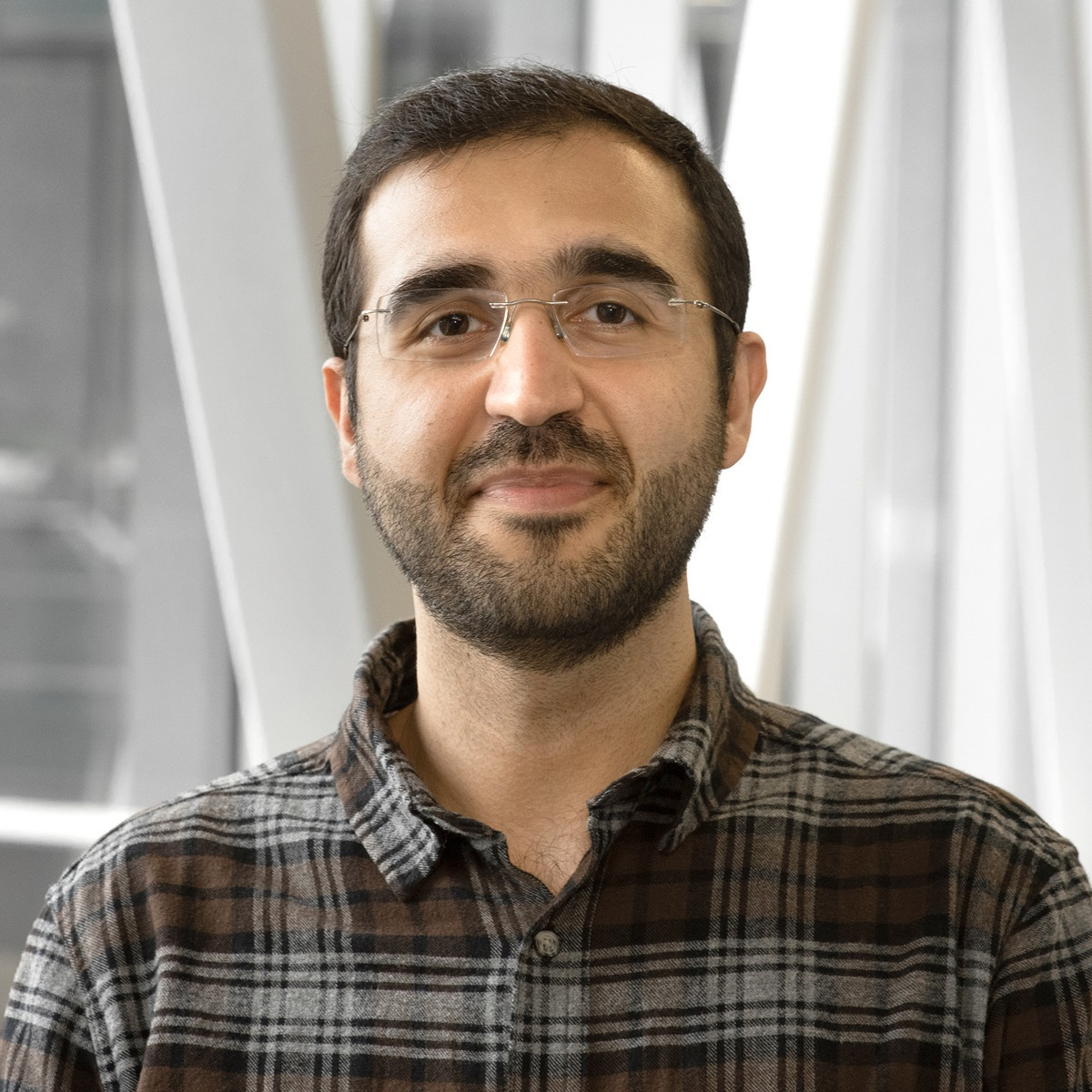
Soutenance de thèse de Mohsen Beikalisotani
Complexe des sciences, 1375, avenue Thérèse-Lavoie-Roux , a3541
Montréal (QC) Canada H2V 0B3
Description
Applications of physics-informed machine learning to contrast-enhanced spectral computed tomography for quantitative purposes
Accurate tissue characterization is essential for radiotherapy treatment planning, as it enables estimation of key parameters such as electron density (re) for photon therapy, stopping power ratio (SPR) for proton therapy, and elemental composition for Monte Carlo dose calculations. Spectral CT techniques—including dual-energy CT (DECT) and photon-counting CT (PCCT)—provide multiple independent measurements per voxel, allowing improved resolution of the chemical complexity of human tissues and leading to more accurate tissue characterization compared with conventional single-energy CT (SECT). However, most quantitative spectral CT methods are originally developed for non-contrast scans. In contrast-enhanced imaging, part of the spectral information must be dedicated to estimating the contribution of the contrast agent, leaving fewer degrees of freedom for characterizing the underlying non-contrast tissues. This limitation is particularly significant for DECT, which provides only two independent measurements.
To address this challenge, this thesis introduces a Bayesian method called dual virtual non-contrast (dual-VNC), which simultaneously estimates VNC Hounsfield units (HU) at low and high energies. This approach restores the degrees of freedom required for accurate tissue characterization in the presence of contrast agents. The estimated VNC images are then used as input to eigentissue decomposition (ETD) for tissue characterization, enabling estimation of radiotherapy-relevant parameters such as SPR, while fully exploiting the spectral information provided by DECT.
The method is further extended to integrate ETD directly within the Bayesian framework and to support PCCT data with any number of energy channels. This extended approach, termed spectral-VNC, enables direct estimation of re and SPR from contrast-enhanced spectral CT data. Moreover, AI-based whole-body segmentation is incorporated as an anatomical prior within the Bayesian formalism, improving parameter accuracy and significantly reducing computation time.
Image-based quantitative methods such as spectral-VNC are designed to operate on polyenergetic reconstructed CT images. However, modern DECT and PCCT systems typically provide a series of virtual monoenergetic images (VMIs) rather than polyenergetic reconstructions, requiring a strategy to select the most informative images as input. This thesis introduces a data-driven VMI selection method based on principal component analysis (PCA), which combines information from the entire VMI set to extract the optimal image pair. These PCA-derived VMIs can be used with spectral-VNC or other quantitative imaging methods. Phantom studies demonstrated that PCA-derived VMIs yield more accurate re and SPR estimates compared with scanner-provided maps from the Philips Spectral CT 7500. Additional simulation studies confirmed their applicability to both SECT and contrast-enhanced DECT scenarios.
Finally, the spectral-VNC method is adapted and applied to a large cohort of head-and-neck cancer patients imaged with contrast-enhanced DECT, where organ-specific statistics for re, SPR, and elemental composition are extracted and compared with literature values. Results showed close agreement with the established Siemens DirectSPR method, while offering a unified framework applicable to both contrast-enhanced and non-contrast data. Overall, this thesis presents a unified, AI-assisted spectral-VNC framework that enables accurate tissue characterization across DECT, and PCCT systems, using either polyenergetic images or VMIs, in both contrast-enhanced and non-contrast scenarios.